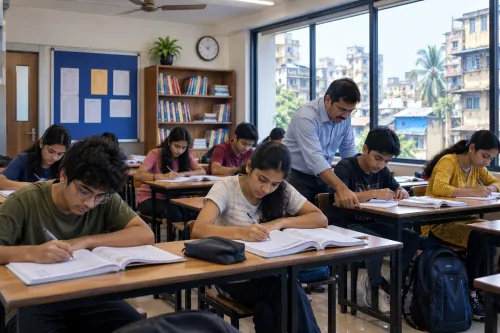
Students in Mahim follow the Maharashtra State Board curriculum and Balbharati textbooks, but the academic demands change sharply from Standard 8 to the SSC year. By comparing subjects, assessment patterns, study routines, and coaching formats, families can choose support that matches the student’s actual needs rather than the class label alone.
Key takeaways
- Standard 8 builds core skills; Standard 10 focuses on SSC examination preparation.
- Practise mathematics, Science and Technology, languages, writing and timed answers every week.
- Use school assessments, unit tests and board-style papers to track progress.
- Choose support based on gaps, teaching pace, feedback quality and travel time.
What changes from Standard 8 to Standard 10?
1. Standard 8 is an 8th Standard foundation stage, not an SSC board year. Students strengthen arithmetic fluency, fractions, decimals, basic algebraic manipulation, reading comprehension, grammar, and clear written answers. Mathematics and Science and Technology require understanding before speed.
English, Marathi, Hindi, Social Sciences, and school-specific subjects need regular reading, vocabulary building, map or diagram familiarity, and complete notebooks.
2. Standard 9 marks 9th Standard preparation for heavier chapters and more formal answers. Students practise multi-step problem-solving, geometry, algebraic procedures, scientific reasoning, evidence-based explanations, and longer written responses. It is not an SSC board-examination year; the school conducts the annual assessment.
Its purpose is to build the workload, accuracy, and answer style required in Standard 10.
3. Standard 10 is the 10th SSC board year under the Maharashtra Secondary School Certificate system. A student following the Maharashtra State Board syllabus in Mahim must complete the prescribed syllabus, use Balbharati definitions and examples accurately, practise written answers under time limits, and revise every subject.
Mathematics needs separate attention to Algebra and Geometry because SSC papers commonly treat them separately. Science preparation must include terminology, labelled diagrams, numericals, applications, and organised explanations rather than memorised shortcut notes. Progress therefore moves from repairing fundamentals, to handling deeper chapters, to producing accurate board-style answers under examination conditions.
Which subjects and skills should students expect to practise?
Expect subject practice to change from foundation-building in Standard 8 to formal reasoning and timed SSC answers in Standards 9 and 10.
| Standard | Mathematics focus | Other classroom skills |
|---|---|---|
| Standard 8 | Calculation accuracy, arithmetic fluency, fractions, decimals, and basic algebra | Textbook reading, grammar, diagrams, definitions, and clear written answers |
| Standard 9 | Algebra, geometry, multi-step problems, and proof-style reasoning | Scientific reasoning, longer answers, evidence, and chronological or geographical understanding |
| Standard 10 | Algebra, Geometry, multi-step application, and accurate steps under time limits | SSC-style answers, labelled diagrams, numericals, map work, and revision |
Science and Technology should combine textbook concepts with scientific vocabulary, labelled diagrams, experiments or activities, numericals, and application questions. Memorising shortcut notes alone can leave gaps in reasoning and diagram marks.
English, Marathi, and Hindi need a separate routine: grammar exercises, comprehension, prescribed-text questions, vocabulary, composition, letter or report writing, and correction of sentence structure. Social Sciences require precise definitions, chronology, geographical understanding, map work, source-based or reasoning answers, and recall of names, places, causes, and consequences.
Use the relevant Balbharati textbook as the first reference for prescribed content. Check its definitions, diagrams, examples, activities, and exercises before relying on commercial notes.
Competitive examinations require separate checking. NMMS in Standard 8 uses a Mental Ability Test and a Scholastic Aptitude Test, each with 90 multiple-choice questions and a 90-minute limit under the central scheme. Verify the organiser, eligibility, syllabus, format, and current notification because a Maharashtra scholarship examination or Olympiad follows different rules.
How are students assessed in each standard?
In Standards 8 and 9, the school—not the Maharashtra State Board SSC system—sets assessment through school unit tests, periodic tests, term examinations, notebook or homework checks, and annual examinations. Practical and activity-based work, projects, oral responses, and other internal assessment requirements can also affect the academic record.
Standard 10 centres on the Maharashtra Secondary School Certificate examination, with school-based or internal components where applicable. Students need more than weekly worksheets: practise chapter tests early in the year, mixed-syllabus tests after several chapters, full-length subject papers, and timed papers using the examination timetable.
Use this assessment checklist:
- Run a diagnostic test, teach the gaps, assign guided homework, correct it, and follow with a chapter test.
- Review every error, revise cumulatively, and finish with full-paper practice.
- Allocate time according to marks, number answers correctly, show mathematical steps, draw and label diagrams, complete map work, and reserve time for checking.
- Ask how missed tests, incomplete homework, repeated errors, and weak language answers are recorded and followed up.
A language answer needs correction for grammar, structure, and completeness, not just a score. Coaching should therefore track written responses alongside concepts, calculations, diagrams, projects, and oral work. A test result without error review shows performance once; a recorded correction cycle shows whether the student is improving.
What should a realistic weekly routine look like in Mahim?
Start your weekly study routine in Mahim by listing fixed commitments before assigning extra work:
1. Write down school hours, travel time, meals, sleep, tuition or study sessions, sports, household duties, and other fixed activities. Leave open space; a timetable that uses every available hour will fail after one late school day.
2. On school days, complete assigned schoolwork and homework before adding worksheets. Give each major subject a short same-day review, such as rereading a Balbharati explanation, correcting classwork, or recalling key definitions.
3. Keep one 30- to 45-minute skill block for arithmetic, algebra, reading, grammar, or vocabulary. Standard 8 students should prioritise daily fundamentals and textbook exercises; Standard 9 students should add independent problem-solving and cumulative revision.
4. Use two longer weekend blocks for difficult Mathematics or Science chapters. Add one block for English, Marathi, Hindi, and Social Sciences, including comprehension, grammar, writing, map work, and prescribed-text questions.
5. Schedule one timed test followed by error correction. Standard 10 students should rotate board-style papers, diagrams, maps, writing correction, and spaced revision of completed chapters instead of repeating only easy chapter exercises.
6. Protect revision and recovery time, sleep, and at least one lighter period each week. During school examination weeks, replace new coaching material with textbook revision and answer practice.
7. Before NMMS or another competition, add timed reasoning sessions and retain school-subject revision. Mental Ability practice cannot replace essential schoolwork or Scholastic Aptitude preparation.
How should families choose the right kind of support?
Choose support based on the student’s actual difficulty, not only the class standard or latest percentage.
| Option | What it means | When it applies |
|---|---|---|
| Regular tuition | Ongoing teaching across subjects | Gaps across several subjects, inconsistent homework, weak retention, or difficulty keeping pace with school chapters |
| Targeted subject support | Focused correction in one area | Problems such as algebraic manipulation, geometry, scientific diagrams, Marathi grammar, English writing, or Social Sciences map work |
| Small-group class | Shared lessons with room for questions and correction | The student can follow a common pace but needs individual feedback |
| Pre-exam revision in Mahim | Timed papers, final revision, and error correction | Foundations are sound; it will not repair major conceptual gaps in a few weeks |
Before enrolling with Shreeraj Classes or another Mahim provider, ask for a diagnostic covering arithmetic, fractions, algebra, reading comprehension, written expression, and retained science concepts. A student who reproduces model answers but fails unfamiliar questions needs conceptual diagnosis, not more memorisation.
Verify these details before paying:
- Does the class use Balbharati textbooks as the primary reference?
- How are doubts, homework, corrections, attendance, and missed work handled?
- How often are chapter tests and cumulative tests conducted?
- Do parents receive progress updates?
- Does the timetable include languages, scientific diagrams, map work, and SSC-style papers?
- Can the institute provide the exact syllabus and competition name before you assume NMMS, a scholarship examination, or an Olympiad is included?
Related products
 | 8th Standard State Board Coaching Classes 8th Standard State Board Coaching Classes Shreeraj Classes in Mahim offers specialized coaching for 8th Standard State Board students, focusing on building a strong academic foundation across... View product → |
 | 10th STD (STATE BOARD) COACHING CLASSES 10th STD (STATE BOARD) COACHING CLASSES Preparing for the 10th class is crucial as it sets the foundation for your future academic pursuits. View product → |
Frequently asked questions
What changes from Standard 8 to Standard 10?
Standard 8 strengthens arithmetic, fractions, decimals, algebra, reading comprehension and grammar. Standards 9 and 10 add greater syllabus depth, longer written answers, regular testing and SSC board preparation.
Which subjects and skills should students practise in Standards 8, 9 and 10?
Students should practise Mathematics, Science and Technology, languages, reading comprehension, grammar, problem-solving, diagram work, written explanations and timed answer writing.
How are students assessed in each standard?
Assessment can include classwork, homework, oral work, unit tests, term examinations, practical or activity-based work and written papers. Standard 10 requires increasing practice with SSC-style question papers and time limits.
What should a realistic weekly routine look like in Mahim?
Plan short, regular study sessions around school, travel and rest. Include daily revision, weekly mathematics and Science and Technology practice, language writing and one timed test or correction session.
How should families choose academic support for Standards 8 to 10?
Compare the support provider’s teaching pace, batch size, doubt-solving process, written feedback, test schedule, school-board alignment and travel time. Choose help that addresses the student’s actual gaps.
Related product
 | 9th STD STATE BOARD COACHING CLASSES 9th STD STATE BOARD COACHING CLASSES Preparing for the 9th class can be a significant step in your academic journey. Here are some general tips to help you with your preparation: 1. View product → |